A bank account can be held as a joint account by two people, which can be a practical solution for anyone with regular shared expenses. But which criteria matter most when choosing one? And which free joint bank accounts in Germany currently offer the best conditions?
The best joint accounts in Germany compared:
N26 Bank Account
- Account Fee: 0 Euro per month
- Cash Withdrawals: Free within the EU zone
- Foreign Currency Fee: 0 Euro worldwide
- Card Type: Mastercard debit card
- Free subaccount for easy budgeting
DKB Bank Account

- Account Fee: 0 Euro per month with 700 Euro incoming payments
- Cash Withdrawals: Free worldwide with active status
- Foreign Currency Fee: 0 Euro worldwide
- Card Type: VISA debit card
- Low overdraft rate
ING Bank Account
- Account Fee: 0 Euro per month with 1.000 Euro incoming payments
- Cash Withdrawals: Free within the EU zone
- Foreign Currency Fee: 2.2% on the total amount
- Card Type: VISA debit card
- Savings account with 3.75% p.a. for 4 months
Targobank Bank Account

- Free account for monthly deposits over 600 Euro
- Extensive branch network with personal advice
- Various account models
- Debit card included – optional credit card
- Free cash withdrawals at Targobank ATMs
comdirect Aktiv Bank Account

- Promotion: 100 Euro bonus
- Account Fee: 0 Euro per month with 700 Euro incoming payments
- Cash Withdrawals: Free worldwide up to 3 times per month
- Foreign Currency Fee: 0 Euro within the EU zone
- Card Type: VISA debit card
Choosing the right joint bank account isn’t always easy. There are many factors to consider, and you can choose from different types of accounts. In this guide, we explain what to look for when selecting the best joint bank account for your needs.
Inhaltsverzeichnis
- The best joint accounts in Germany compared:
- What is a joint account?
- Who can open a joint account?
- The advantages of a joint account
- The disadvantages of a joint account
- Which is the best joint account in Germany?
- How do you open a free joint account in Germany?
- Closing a free joint account
- How can a joint account be converted into a single account?
- What happens to a joint account in the event of inheritance?
- Free joint bank accounts in Germany compared: Our conclusion
- Frequently asked questions about joint accounts in Germany
What is a joint account?
A joint account is generally a bank account that is managed by multiple account holders. Savings accounts or fixed-term deposit accounts can also, in some cases, be used as joint accounts.
This type of account is also referred to as a partner account and is usually opened in addition to an existing individual account to make financial management easier when two people combine their finances.
For instance, couples or shared households often have joint expenses such as rent and utilities, which can be managed through a joint account.

Because both people are account holders and thus have equal access to the account, paying such bills becomes significantly more efficient.
However, when opening such a partner account, one can choose between two different types of accounts. This concerns the aspect of account rights. The two account holders can either choose a so-called “both-to-sign account” or an “either-or account.”
Either-or account (German: Oder-Konto)
One variant of the joint account in Germany is called an “either-or account”. This simply means that both account holders can access the partner account independently of each other.
This is the default option at most banks because account management can be more independent and flexible. Both account holders can perform the following functions without the consent of the other:
- Transfers
- Cash withdrawals
- Direct debit authorizations
Of course, at first glance, this type of account seems simpler and more flexible. With the joint account, expenses such as groceries do not need to be constantly transferred back and forth, which saves a considerable amount of time.
The “either-or account” is therefore usually suitable for married couples and domestic partnerships. However, this type of account management requires a certain level of trust, as rights can be exercised without the other account holder. In other situations, a different type of account may be more appropriate.
Both-to-sign account (German: Und-Konto)
With a so-called “both-to-sign” account, the process of managing the account becomes more complicated. Unlike the “either-or account”, the respective account holders cannot carry out transactions without the consent of the other.
This has the advantage that both parties constantly maintain some control over their account and are therefore always secured. Still, it should be noted that autonomous account activities are significantly restricted, and payment transactions become more time-consuming.
Who can open a joint account?
Since many people are unsure how many bank accounts they are allowed to have and whether they should open another one, the question of who can actually open a joint account also arises in this area.
Primarily, a joint account is of course useful for partnerships and married couples, as it is especially suitable for managing shared finances in a time-saving manner. It may even happen that some banks require a matching registered address to open a partner account.

Similarly, it can also be advantageous for shared households to open a separate financial account. Fixed costs such as rent and additional expenses can thus be deposited into the account proportionally.
In principle, it can be said that a joint bank account always makes sense when sharing a household with another person. The different account variants of the “both-to-sign account” and “either-or account” also aim to ensure that the joint account can be tailored to the individual needs of the respective persons.
The advantages of a joint account
A joint account can offer many advantages for both partnerships and shared households. The different account types are tailored to the needs of different groups and can thus make joint household finances more transparent.
In addition, a joint account can be managed by more than two people, as some banks also offer checking accounts for multiple account holders. This is particularly advantageous for shared households, which can then collect amounts such as rent and utilities in a separate account.

With a partner account, all account holders have equal access to the account, which also makes household management much easier. The fact that the respective shares transferred to the joint account can be regulated also guarantees a fair distribution of shares.
Another advantage of a joint account is the bank cards that are available to all authorized users. All account holders can therefore conveniently pay with their individual bank card, provided that the partner account is a joint account.
Joint account or individual account?
Are the advantages of a joint account really worth it? Of course, people are also free to continue using separate individual accounts and thus manage their joint finances among themselves.
However, it is not possible to say in general terms whether a joint account is more worthwhile, as the individual situation always plays an important role and the type of account also depends on this.
In principle, however, it is advisable to consider combining two accounts into a joint account for clear household management, as this allows monthly fixed costs and joint expenses to be divided more fairly. However, before opening an account, you should compare all options to determine whether a joint account is really worthwhile.

Private individuals are also permitted to grant another person access to their individual account. This person then has unrestricted access to the bank account, which can be practical on the one hand, but also involve many risks on the other.
In some situations, it is therefore advisable to open a joint account, as both account holders are equally liable, for example, in the event of an overdraft. However, despite the greater flexibility, it is important to weigh up all the conditions.
N26 Bank Account
- Account Fee: 0 Euro per month
- Cash Withdrawals: Free within the EU zone
- Foreign Currency Fee: 0 Euro worldwide
- Card Type: Mastercard debit card
- Free subaccount for easy budgeting
DKB Bank Account
- Account Fee: 0 Euro per month with 700 Euro incoming payments
- Cash Withdrawals: Free worldwide with active status
- Foreign Currency Fee: 0 Euro worldwide
- Card Type: VISA debit card
- Low overdraft rate
ING Bank Account
- Account Fee: 0 Euro per month with 1.000 Euro incoming payments
- Cash Withdrawals: Free within the EU zone
- Foreign Currency Fee: 2.2% on the total amount
- Card Type: VISA debit card
- Savings account with 3.75% p.a. for 4 months
Targobank Bank Account
- Free account for monthly deposits over 600 Euro
- Extensive branch network with personal advice
- Various account models
- Debit card included – optional credit card
- Free cash withdrawals at Targobank ATMs
comdirect Aktiv Bank Account
- Promotion: 100 Euro bonus
- Account Fee: 0 Euro per month with 700 Euro incoming payments
- Cash Withdrawals: Free worldwide up to 3 times per month
- Foreign Currency Fee: 0 Euro within the EU zone
- Card Type: VISA debit card
Although a joint account can be advantageous due to the above-mentioned aspects, it also has a few disadvantages that should be considered before opening the account.
The disadvantages of a joint account
In addition to simplifying household finances, there are some drawbacks to a joint account in Germany that should be examined more closely. Opening a joint account can also raise legal issues.
All disadvantages at a glance:
- Court order for attachment (Pfändungsbeschluss in German)
- Gift tax
With autonomous account management, as is usual with an “either-or account”, account holders can also act independently and without their partner’s knowledge. This carries a certain risk, as, for instance, the overdraft limit of the respective joint account can be exhausted without notice.
Court order for attachment
If a court order for attachment of funds is issued against one of the account holders, the resulting account attachment may, for instance, also affect the couple’s joint account. At the first signs that an attachment may be imminent, it is therefore advisable to transfer money to your personal account.
This is because, in order to protect funds in the event of attachment, an individual account in Germany can usually be converted into a so-called protected account (Pfändungsschutzkonto, P-account). This is not possible with a joint account, which means that in such a case it may be unclear to what extent access to the account will be restricted.
This is because, in order to protect your money in the event of a garnishment, you can usually convert an individual account into a so-called garnishment-protected account (P-account). However, this is not possible with a joint account, so access to the account remains unclear in such a case.
Gift tax
Legal problems can also arise if large sums of money are paid into the joint account. As both account holders have access to this money, the tax office could interpret this as a gift.

As a result, gift tax may be charged based on the value of the gift. To avoid this, you should not deposit too large sums into the joint account or continue to maintain a separate individual account.
Which is the best joint account in Germany?
As a rule, you can judge which checking accounts tend to be more worthwhile as partner accounts based on their terms and conditions and advantages. Checking accounts from traditional German branch banks such as Sparkasse, Volksbank, and Deutsche Bank are usually the most expensive models on the financial market, as they charge high account maintenance fees compared to modern neobanks.
Additionally, banks such as HypoVereinsbank may apply extra charges on top of the monthly fee. That can make the account less attractive over time, even if it offers advantages such as in-branch, personal advice.
Our reisetopia financial experts definitely recommend looking elsewhere for suitable joint accounts. We’ve done the research for you and found attractive joint account options in 2026 that we’d like to introduce below.
Free joint accounts
No monthly or annual fees make free bank accounts attractive. But the key question is: are those fees being recouped somewhere else?
It is therefore worth comparing the individual terms and conditions of the various joint accounts in advance. Some branch banks also offer free joint accounts, so you don’t have to forego personal advice.
In addition, there are several offers from direct banks that offer digital joint accounts. Although neobanks cannot guarantee personal advice, they do offer other advantages. These include modern and mobile online banking, free bank cards, and favorable terms for transactions and cash withdrawals.
For instance, although the neobank N26 does not offer a traditional joint account, if you have a checking account, you can set up multiple sub-accounts using the Shared Spaces feature and transfer the rights of disposal to other people.
N26 Checking account
- Free checking account
- Tested by Stiftung Warentest 12/25
- Free withdrawals in the Eurozone
- Free payments in foreign currencies
- Cash deposits possible at selected retail branches
- Mobile banking via app


Three-account model
If you can’t decide whether a joint account makes sense in your individual situation, there is also the option of a three-account model. With this model, both account holders keep a separate checking account and open a third account as a partner account.
This account is then used exclusively for joint finances, such as fixed costs. Both account holders can thus make proportional deposits into the joint account and set fair terms individually. In view of the risks mentioned above that can arise with a joint account, this option is often a good choice.
How do you open a free joint account in Germany?
Before opening a joint account, you should always compare all providers and decide individually which one is best suited to your needs. Both individuals must then fill out an application for the partner account and verify their identity with the respective bank.
As with opening a normal checking account, this is also done using the Postident procedure. Alternatively, personal documents (valid passport or ID card) can also be verified using the video identification procedure.
The latter method saves a lot of time, as the video chat with a bank employee can be completed in just a few minutes. Unlike when opening a normal checking account, the details of the second person and their signature must also be submitted.
Closing a free joint account
If you decide to close a joint account for different reasons, there are a few things you should keep in mind. First, the cancellation must be submitted in writing by letter or fax. The only exception is joint accounts opened after 2016, as it has been possible to close these accounts by email since then.
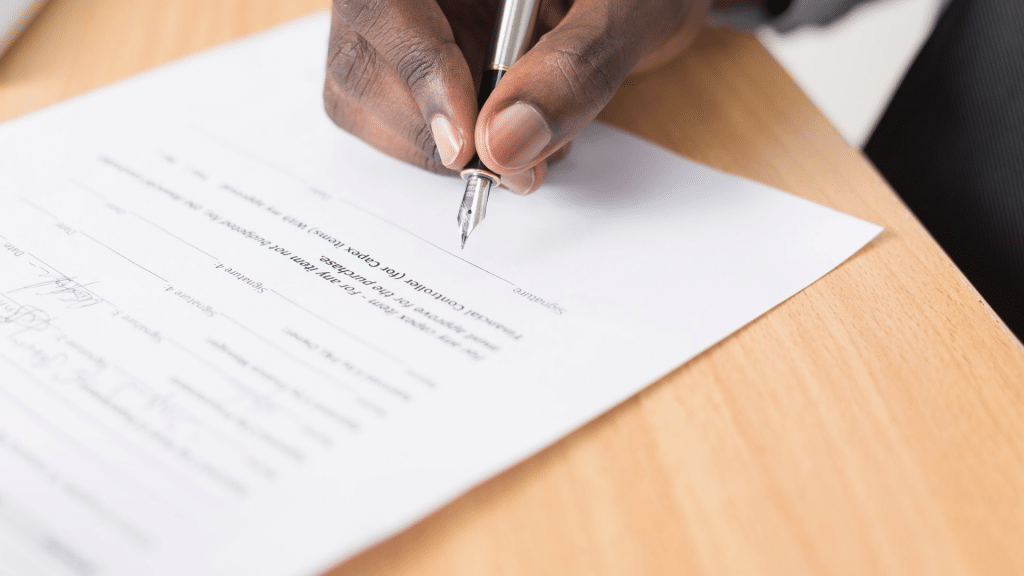
In addition, all authorized signatories must sign the written notice of termination and agree to the closure. Without the consent of both account holders, this is not possible.
How can a joint account be converted into a single account?
It is also possible to convert a joint account into a single account. To do this, the partner account must first be balanced, which means that the account must not be overdrawn and must not have an excessively high balance.
It should also be noted that any overdraft facility should not be exhausted, as this makes conversion by the respective bank less likely, as it would have to take on higher financial risks.
The respective bank is not legally obliged to convert the joint account into a single account. In most cases, account holders are obliged to close the joint account under certain conditions.
What happens to a joint account in the event of inheritance?
Since two people have access to the money deposited in a joint account, it is essential to be prepared for the worst-case scenario. After death, there may be a number of consequences that should be clarified in advance.

If one of the account holders of a joint account dies, their heirs are entitled to the balance. If the shares have not been specified in writing beforehand, they are then usually entitled to 50 percent of the amount in the joint account, even if one of the shareholders has deposited larger sums.
There is also a significant difference with a “both to sign account”. Since the account holders in this account model can only access the partner account with mutual consent, the account holder’s heirs take over in the event of death. It is therefore advisable to record the shares in writing at an early stage. For this reason, it is generally not advisable to keep large amounts in a joint account.
In addition, with an “either-or account”, it is possible to withdraw the sole power of disposal in the event of the death of an account holder. This means that the partner account is converted into an “both to sign”, so that the heirs must obtain the consent of the existing account holder for each transaction.
This can be particularly useful for communities of heirs, as there may not be a basis of trust essential for a joint account, thus preventing misuse.
Free joint bank accounts in Germany compared: Our conclusion
A joint account in Germany can be particularly advantageous for clear household budgeting. A distinction is made between a “both to sign account” and an “either-or account”. The latter requires mutual trust between both account holders and allows independent account management. With an “both to sign account”, on the other hand, both authorized signatories must always confirm the respective actions, such as transfers and cash withdrawals.

However, before opening a joint account, it is important to note that certain risks may arise in the event of attachment or legal issues such as gift tax. Most branch and direct banks offer joint accounts, but it is important to carefully review the individual terms and conditions and use them to assess which joint account is best for your individual situation.
Branch banks, for example, tend to offer more expensive partner accounts that provide unsatisfactory services compared to low-cost or even free checking accounts from direct banks. The free joint account from N26, for example, is therefore more recommendable, as it guarantees free cash withdrawals and free credit cards, among other things.
N26 Bank Account
- Account Fee: 0 Euro per month
- Cash Withdrawals: Free within the EU zone
- Foreign Currency Fee: 0 Euro worldwide
- Card Type: Mastercard debit card
- Free subaccount for easy budgeting
DKB Bank Account
- Account Fee: 0 Euro per month with 700 Euro incoming payments
- Cash Withdrawals: Free worldwide with active status
- Foreign Currency Fee: 0 Euro worldwide
- Card Type: VISA debit card
- Low overdraft rate
ING Bank Account
- Account Fee: 0 Euro per month with 1.000 Euro incoming payments
- Cash Withdrawals: Free within the EU zone
- Foreign Currency Fee: 2.2% on the total amount
- Card Type: VISA debit card
- Savings account with 3.75% p.a. for 4 months
Targobank Bank Account
- Free account for monthly deposits over 600 Euro
- Extensive branch network with personal advice
- Various account models
- Debit card included – optional credit card
- Free cash withdrawals at Targobank ATMs
comdirect Aktiv Bank Account
- Promotion: 100 Euro bonus
- Account Fee: 0 Euro per month with 700 Euro incoming payments
- Cash Withdrawals: Free worldwide up to 3 times per month
- Foreign Currency Fee: 0 Euro within the EU zone
- Card Type: VISA debit card
Frequently asked questions about joint accounts in Germany
What services does a joint account offer?
A joint account can be very useful for managing shared finances. Shared expenses and fixed costs can be managed more conveniently and without constantly transferring the respective shares back and forth. This saves time, of course, but also requires a certain level of trust. However, there are two types of joint accounts to choose from, each of which is suitable for different types of partnerships. The advantages of a joint account also include separate debit or credit cards, which make household budgeting more time-efficient.
Should you open a joint account or a separate account?
Both types of joint accounts are suitable for different needs. With an “either-or account”, both account holders have independent access to the partner account and can, for example, make transfers and withdrawals independently. With a “both-to-sign account”, actions are restricted, as the authorized users must agree on every account movement. Therefore, it depends heavily on the individual situation and the relationship between the account holders, as trust also plays a major role.
Are both account holders individually verified for a joint account?
Yes, for joint accounts, every account holder is required to undergo separate verification to ensure legal compliance and individual recognition by the bank.
What happens to a joint account in the event of inheritance?
If one of the account holders unexpectedly passes away, their heirs automatically become entitled to the shares in the joint account. It is advisable to determine the entitlements to the respective shares at an early stage in order to avoid later disputes in the event of inheritance. Account holders also have the option of converting an “either-or account” into an “both-to-sign account” in order to restrict the individual disposal rights of the heirs.
Do both account holders need a positive credit record (Schufa) for a joint account?
Yes, both account holders are generally expected to have a positive credit record (Schufa) to ensure eligibility for a joint account, although exact requirements may vary by bank.